INSIGHT Partners from NovaMechanics and the University of Birmingham have developed a repository offering ready-for-modelling NMs datasets integrating physicochemical characterisation, mechanistic toxicity, exposure, and risk assessment data, enriched with atomistic, structural, molecular, and periodic table-based descriptors.
A detailed description of the repository can be found in their publication entitled ‘nanoPharos: A case study on FAIR (Nano)material (Meta)data management’.
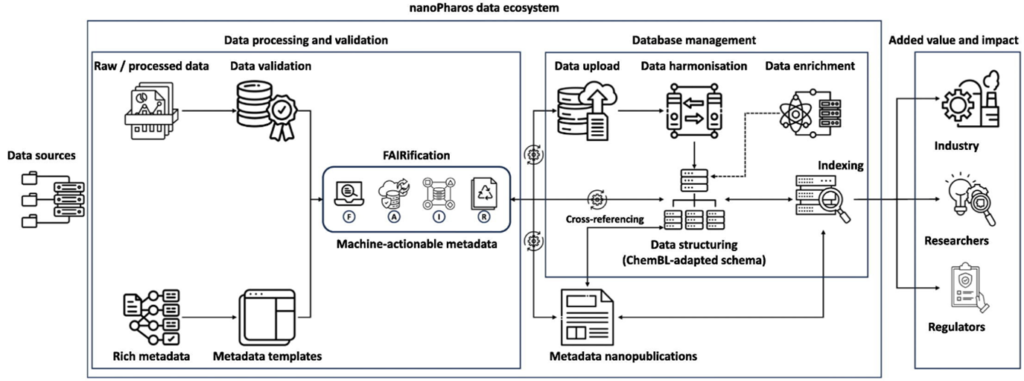
This paper introduces nanoPharos, a public database within the Pharos data ecosystem developed by NovaMechanics, dedicated to organising data on novel and advanced materials, including nanomaterials (NMs). Published by Papadiamantis et al., in December 2025 and as the March 2026 EUON Nanopinion, the piece explains how nanoPharos applies the FAIR (Findable, Accessible, Interoperable, Reusable) principles to materials data, covering physicochemical characterisation, mechanistic toxicity, exposure and risk-assessment endpoints, alongside computational descriptors that span the unit-cell, atomistic, molecular and periodic-table scales.
Bringing novel and advanced (nano)materials safely and sustainably to market depends on large volumes of high-quality, interoperable data. In practice, NM datasets are scattered across publications and repositories in inconsistent formats, with patchy provenance and limited machine-readability. This slows modelling, hampers reproducibility, and undermines confidence in the evidence used for regulation and design. Reducing reliance on animal testing through New Approach Methodologies (NAMs), and meeting the European Union’s Safe-and-Sustainable-by-Design (SSbD) ambitions, both require a trustworthy, reusable data layer that today’s repositories do not consistently provide.
nanoPharos is, to our knowledge, the first nanomaterials repository explicitly engineered around FAIR-by-design principles for modelling-ready data. Its distinctive features include: (i) a relational schema adapted from ChEMBL and extended to capture NM complexity from unit cell to macroscopic properties; (ii) 119 computational descriptors enriching every entry; (iii) integration of physicochemical, toxicity, exposure and risk data with rich bibliographic and provenance metadata; (iv) globally unique, persistent identifiers via the European Registry of Materials (ERM) and NanoInChI, ensuring unambiguous referencing across studies; and (v) full machine-actionability, so datasets can be queried and consumed by downstream nanoinformatics pipelines without manual reformatting. A FAIRness self-assessment using the Joint Research Centre indicators rose from 10/41 (24%) in 2020 to 33/41 (81%), demonstrating substantial and measurable progress.
The INSIGHT project is building an integrated framework for Safe-and-Sustainable-by-Design assessment of chemicals and advanced materials, in which the quality, traceability and reusability of input data are decisive for credible decisions. nanoPharos provides INSIGHT with this data backbone, i.e., curated, FAIR-aligned, machine-actionable (nano)materials datasets that feed the project’s computational SSbD workflows, NAM-based predictive models and risk-assessment pipelines. Persistent identifiers (ERM, NanoInChI) ensure that the same material can be tracked unambiguously across hazard, exposure and life-cycle dimensions; rich provenance metadata make every recommendation auditable; and long-term hosting of datasets and models supports regulatory uptake and reuse beyond the project’s lifetime. In short, nanoPharos provides the FAIR data layer for the development of a transparent and reproducible SSbD framework for INSIGHT.
Follow these links to read the Nanopinion piece, or to access the full paper.