Colleagues from many INSIGHT Partners in a joint effort have published a new paper on the Easy-MODA webtool available on the Enalos Cloud Platform.
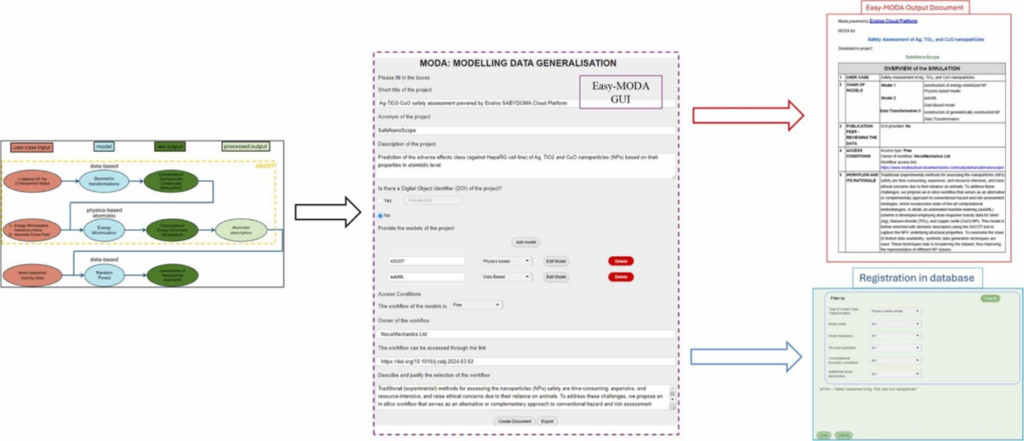
The paper presents the development of Easy-MODA, a user-friendly web tool designed to simplify and standardize the process of MODA documentation. The tool guides users through completing the required fields by dynamically adapting options based on their previous selections, ensuring that the documentation of scientific simulation workflows is consistent, complete, and easy to reproduce. The importance of Easy-MODA has also been recognized by the European Chemicals Agency’s EUON (European Union Observatory for Nanomaterials), where it was recently featured as a Nanopinion article entitled ‘Easy-MODA: A Web-Tool to enhance the FAIRness of Materials Models through the Registration of scientific Simulation workflows’.
In materials science and nanotechnology, researchers and companies increasingly rely on a combination of complex computational models—ranging from physics-based simulations to machine learning approaches—to predict material behavior, safety, and sustainability early in the development process. Given the growing complexity and need for transparency and explainable AI, clear and harmonized documentation of these modelling workflows is essential. Easy-MODA addresses this need by offering a free, web-based platform that facilitates the registration of simulation workflows, ensuring their reproducibility and enabling their reuse by others.
Modelling Data (MODA) reporting guidelines have been proposed for common terminology and for recording metadata for physics-based materials modelling and simulations in a CEN Workshop Agreement (CWA 17284:2018). Their purpose is similar to that of the Quantitative Structure-Activity Relationship (QSAR) model report form (QMRF) that aims to increase industry and regulatory confidence in QSAR models, but for a wider range of model types. Recently, the WorldFAIR project’s nanomaterials case study suggested that both QMRF and MODA templates are an important means to enhance compliance of nanoinformatics models, and their underpinning datasets, with the FAIR principles (Findable, Accessible, Interoperable, Reusable). Despite the advances in computational modelling of materials properties and phenomena, regulatory uptake of predictive models has been slow. This is, in part, due to concerns about lack of validation of complex models and lack of documentation of scientific simulations. The models are often complex, output can be hardware- and software-dependent, and there is a lack of shared standards. Despite advocating for standardised and transparent documentation of simulation protocols through its templates, the MODA guidelines are rarely used in practice by modellers because of a lack of tools for automating their creation, sharing, and storage. They also suffer from a paucity of user guidance on their use to document different types of models and systems. Such tools exist for the more well-established QMRF and have aided widespread implementation of QMRFs. To address this gap, a simplified procedure and online tool, Easy-MODA, has been developed to guide users through MODA creation for physics-based and data-based models, and their various combinations. Easy-MODA is available as a web-tool on the Enalos Cloud Platform. The tool streamlines the creation of detailed MODA documentation, even for complex multi-model workflows, and facilitates the registration of MODA workflows and documentation in a database, thereby increasing their Findability and thus Re-usability. This enhances communication, interoperability, and reproducibility in multiscale materials modelling and improves trust in the models through improved documentation. The use of the Easy-MODA tool is exemplified by a case study for nanotoxicity evaluation, involving interlinked models and data transformation, to demonstrate the effectiveness of the tool in integrating complex computational methodologies and its significant role in improving the FAIRness of scientific simulations.
The authors identified and mapped the logical connections between different fields in the MODA documentation template. Based on this, we developed a tool that dynamically presents compatible options depending on the user’s previous selections. For example, choosing a quantum mechanical or atomistic model prompts the user to specify parameters like the exchange-correlation functional or force field, making the documentation process more intuitive and error-proof.
The tool supports the Safe and Sustainable by Design (SSbD) framework by enabling the reuse and adaptation of previously documented modelling workflows. Scientists can retrieve detailed workflows from the Easy-MODA database, replicate or tailor them for their specific case studies, and avoid duplicating effort. By encouraging the registration and sharing of new workflows, Easy-MODA promotes transparency, knowledge transfer, and the faster deployment of safe and sustainable solutions in line with the goals of the INSIGHT project.
Find the full text publication here.