INSIGHT colleagues from TAU contributed to a publication on nanomaterial grouping. Grouping is a fundamental step to generalize engineered nanomaterials (ENM) hazard. However, most strategies lack comprehensiveness in ENM and experimental settings. Toxicogenomics allows the characterization of the direct molecular mechanisms of action (MOA) associated to ENM hazard.
In this study, an adverse outcome pathway (AOP)-based framework for ENM grouping was implemented. The authors hypothesized that AOP-direct MOA along with ENM potency, i.e., the dose required to activate a molecular response, could be used to robustly group distinct ENM exposures by considering a mechanistic and multiscale level of response. The results highlighted a critical role of the exposure duration and ENM potency respectively on the specificity and progression of the response. Moreover, the authors investigated the complexity and time scale of the biological events triggered by ENM. In particular, genotoxicity-related AOPs were found triggered at longer exposures. Higher ENM potency was linked to shorter exposure and basic and starting events. While lower potency was linked to prolonged exposures and advanced stages of biological processes. The results also highlighted shared molecular responses in groups of ENM both at shorter (5 clusters) and longer (3 clusters) exposure periods. Based on computed features for cluster predictions, grouping could have likely resulted from the influence of chemical composition, size-dependent properties of ENM, and biological descriptors.
Although these exceptional materials have many useful applications, their small size and unique properties raise concerns about their potential risks. Today, there is not an established method to group them based on their health impacts, which makes safety assessment challenging.
The study aimed to address this gap by providing a comprehensive strategy for grouping them.
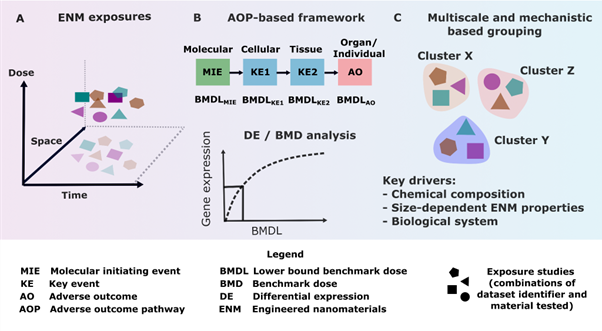
The novelty lies in the combination of an AOP-based framework with overall changes in genes to group distinct material exposures. AOP framework maps out a chain of events that starts with a molecular interaction, such as how materials affect the homeostasis of genes and how these effects could reflect in broader effects, such as tissue damage.
Hence, this approach allows us to understand specific biological processes and interactions that occur at various levels or scales, such as time and space (from cells to tissues and entire organisms). Therefore, we can understand how small scale interactions, like molecular interactions, can lead to large scale effects, such as overall health effects.
Additionally, the authors incorporate findings from multiple studies to capture a thorough and reliable picture of responses caused by distinct materials and conditions, and considered computationally and experimentally derived characteristics of these materials to categorize them.
Finally, features were interdependent and differed in quantity and connectivity, indicating differences in the response dynamics. Notably, the study does not include every ENM currently available. Hereby, the findings pave the way for the construction of quantitative AOPs and hold significant implications for ENM hazard assessment and regulatory decision-making.
Conclusions
The study finds that when living organisms are exposed to these materials for longer periods, they often show change in genes that sign DNA damage. The strength or how toxic these materials also affect how organisms respond. The authors identified different materials that cause similar biological responses, both in short and long exposures. Such responses are mainly influenced by the chemical composition and size of the material, as well as biological characteristics of the organism tested.
This paper is important for the Safe and Sustainable by Design (SSbD) framework because it provides an integrative and mechanistic approach to assess material safety. By linking molecular interactions to large scale biological effects and overall gene level analysis, our approach offers a predictive strategy for grouping materials based on their impacts. This aligns with INSIGHT’s goal of embedding mechanistic understanding into SSbD, ensuring material design is both safe and sustainable.
Find the full text publication here.
Related publication: Torres Maia, Marcella, et al. “Nanomaterial grouping: Unraveling the relationship of induced mechanisms and potency at a temporal scale.” Nano Today 61 (2025): 102639. https://doi.org/10.1016/j.nantod.2025.102639.