Researchers from the INSIGHT project have published a review paper on predictive models and model-integration strategies for the holistic impact assessment of chemicals and materials, with a specific focus on their application within the Safe and Sustainable-by-Design (SSbD) framework. The paper entitled ‘Review on Predictive Models and Integration Strategies for Holistic Impact Assessment of Chemicals and Materials’ (https://doi.org/10.1021/acs.est.5c04489) covers models addressing human health, environmental safety, exposure, life cycle sustainability, and socioeconomic impacts, and examines how these can be combined to move beyond fragmented assessments.
The motivation for this work stems from the increasing pace of innovation in chemicals and materials, which has outgrown traditional assessment approaches that typically address safety, environmental, and sustainability aspects in isolation. Such fragmented assessments limit the ability to understand interactions between impact domains. The paper responds to the need for an integrated, mechanistic, multiscale impact assessment that align with the SSbD framework.
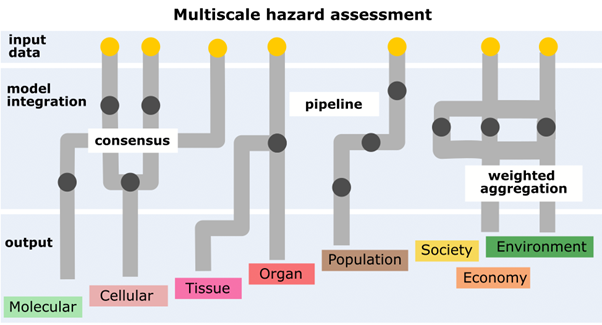
The novelty of this paper lies in its systematic focus on how predictive models can be integrated rather than solely on the models themselves. It identifies and conceptualizes three complementary integration strategies (consensus integration, weighted aggregation, and pipeline integration) and discusses their respective roles, strengths, and limitations in SSbD-relevant assessments. In addition, the paper explicitly addresses uncertainty propagation and applicability domain issues in integrated frameworks and introduces the concept of Impact Outcome Pathways (IOPs) as a multiscale extension of Adverse Outcome Pathways (AOPs), enabling alignment of heterogeneous models and data streams across biological, environmental, and socioeconomic dimensions.
This paper is highly relevant for the SSbD framework within INSIGHT because it provides the conceptual and methodological foundation needed to operationalize integrated impact assessment in practice. It directly supports the ambition to move beyond siloed evaluations by demonstrating how predictive models can be coherently connected across domains and scales through the unified IOP framework, which is central to the INSIGHT strategy.
Follow this link to read the full paper.