INSIGHTS Partner TAU has published a new paper entitled ‘A Network Toxicology Approach for Mechanistic Modelling of Nanomaterial Hazard and Adverse Outcomes’.
Hazard assessment is the first step in evaluating the potential adverse effects of chemicals. Traditionally, toxicological assessment has focused on the exposure, overlooking the impact of the exposed system on the observed toxicity. However, systems toxicology emphasizes how system properties significantly contribute to the observed response. Hence, systems theory states that interactions store more information than individual elements, leading to the adoption of network based models to represent complex systems in many fields of life sciences.
One of the biggest challenges in modern toxicology is understanding how small molecular changes caused by chemicals and materials can lead to large-scale effects on human health and the environment. While we’ve made progress in identifying harmful substances, current methods often struggle to explain how these effects happen. This gap makes it difficult to predict the risks posed by new materials or chemicals, slowing efforts to develop safer products and protect public health.
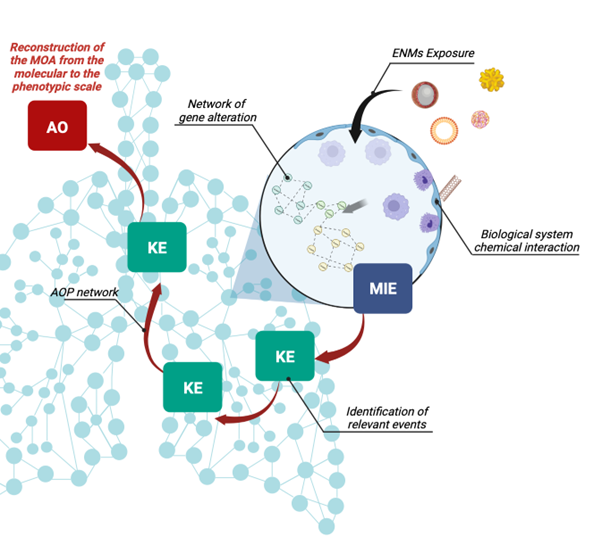
To tackle this challenge, we developed a new strategy that links molecular changes, such as shifts in how genes are expressed, to broader biological effects, like organ damage or diseases. Our framework uses network models (essentially interactions within entities) to show how small disruptions can ripple through organisms, creating a clearer picture of how harm develops over time.
Observations
We focused on nanomaterials, tiny particles much smaller than a human cell, with unique properties that make them useful in products like electronics, cosmetics, and medicines. While these properties drive innovation, they also raise important safety concerns. To test our framework, we studied the effects of 31 different nanomaterials on three types of biological systems. These nanomaterials were selected because they are widely used in industry and have varying levels of known safety risks. By analyzing their effects, we discovered patterns in how biological systems respond to nanomaterials, identifying both shared features and unique differences depending on the material and the biological test system.
Results
Our study showed that this network-based approach provides clearer and more detailed insights than traditional methods. It not only identifies harmful materials but also explains why they are harmful, by tracing how small molecular changes can lead to larger health effects. This approach is also versatile: while we focused on nanomaterials, it can be applied to any type of chemical exposure. This makes it a powerful tool for toxicologists and regulators to assess the safety of both existing substances and new materials.
While more work remains to fully achieve our vision of mechanism-based toxicology, this study marks an important step forward. By bridging molecular biology and toxicology, our approach offers a more comprehensive way to assess risks and protect human and environmental health. This work aligns closely with the goals of the INSIGHT project, which focuses on integrating innovative methods into risk assessment frameworks. The framework supports INSIGHT’s safe-and-sustainable-by-design principles, highlighting the possible mechanisms of toxicity from molecular profiling. Its adaptability makes it a valuable tool for developing safer chemicals and materials, contributing to a healthier and more sustainable future.
Find the full text of the publication here.
Related publication
Del Giudice, Giusy, et al. “A network toxicology approach for mechanistic modelling of nanomaterial hazard and adverse outcomes.” Advanced Science 11.32 (2024): 2400389. https://doi.org/10.1002/advs.202400389.