INSIGHT colleagues contributed to a publication entitled The FAIR principles as a key enabler to operationalize safe and sustainable by design approaches.
Safe and sustainable development of chemicals, (advanced) materials, and products is at the heart of achieving a healthy future environment in line with the European Green Deal and the Chemicals Strategy for Sustainability. Recently, the Joint Research Center (JRC) of the European Commission (EC) developed the safe and sustainable by design (SSbD) framework for definition of criteria and evaluation procedure proposed to be established in Research and Innovation (R&I) activities. The framework aims to support the design of chemicals, materials and products that provide desirable functions (or services), while simultaneously minimizing the risk for harmful impacts to human health and the environment.
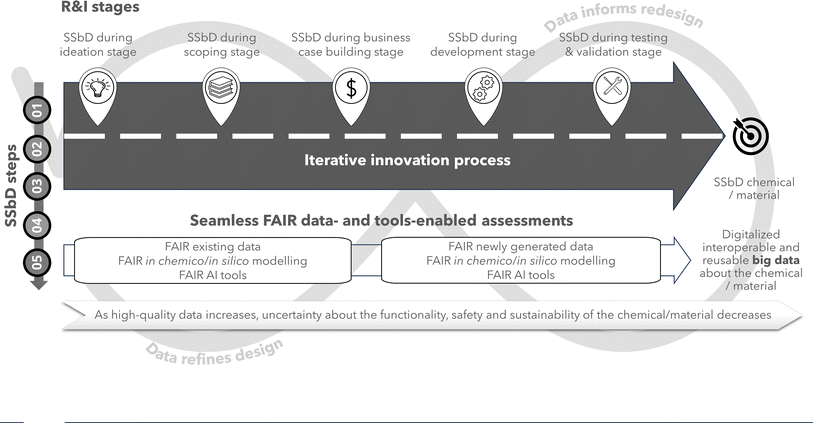
The motivation for this paper is to support the safe and sustainable development of chemicals, materials, and products in line with the European Green Deal and the Chemicals Strategy for Sustainability. While the Safe and Sustainable by Design SSbD framework aims to harmonize safety and sustainability assessments across sectors, its successful implementation depends on high-quality, interoperable data and tools. The paper emphasizes how the FAIR principles can enhance digitalization, transparency, and trust in the SSbD framework, ultimately driving innovation toward a greener transition.
While many industrial sectors already consider such aspects during R&I, the framework aims to harmonize safety and sustainability assessment across diverse sectors and innovation strategies to meet the mentioned overarching policy goals. A cornerstone to successfully implement and operationalize the SSbD framework lies in the availability of high-quality data and tools, and their interoperability, aspects which also play a key role in ensuring transparency and thereby trust in the assessment outcomes. Availability of data and tools depend on their machine-actionability in terms of findability, accessibility, interoperability, and reusability, in line with the FAIR principles. The principles were developed in order to harmonize digitalization across all data domains, supporting unanticipated data-driven “seamless” integration of information and generation of new knowledge. Here we discuss the essentiality of FAIR data and tools to operationalize SSbD providing views and examples of activities within the European Partnership for the Assessment of Risks from Chemicals (PARC).
The discussion covers five areas previously brought up in relation to the SSbD framework, and which are highly dependent on implementation of the FAIR principles; (i) digitalization to leverage innovation towards a green transition; (ii) existing data sources and their interoperability; (iii) navigating SSbD with data from new scientific developments (iv) transparency and trust through automated assessment of data quality and uncertainty; and (v) “seamless” integration of SSbD tools.
This paper is important for the SSbD framework in the INSIGHT project because it demonstrates how the FAIR principles can address key challenges in implementing safe and sustainable innovation for chemicals, materials, and products. While the SSbD framework provides a structured approach to minimize environmental and human health risks, its success relies heavily on high-quality, interoperable data and digital tools. The paper highlights how FAIR principles can ensure consistency across sectors, facilitate seamless integration of existing and emerging data sources, and enable automated assessments of data quality and uncertainty. By promoting transparency and trust in decision-making processes, the paper positions FAIR data and tools as essential enablers for operationalizing the SSbD framework and achieving the goals of the European Green Deal and the Chemicals Strategy for Sustainability.
The full text publication can be found here.