INSIGHT researchers recently launched LungDepo – a freely accessible online web application hosted on the Enalos Cloud platform – that enables users to simulate particle deposition in the human lung across the head airway, the tracheobronchial and the alveolar (pulmonary) regions based on the aerodynamic diameter of inhaled particles.
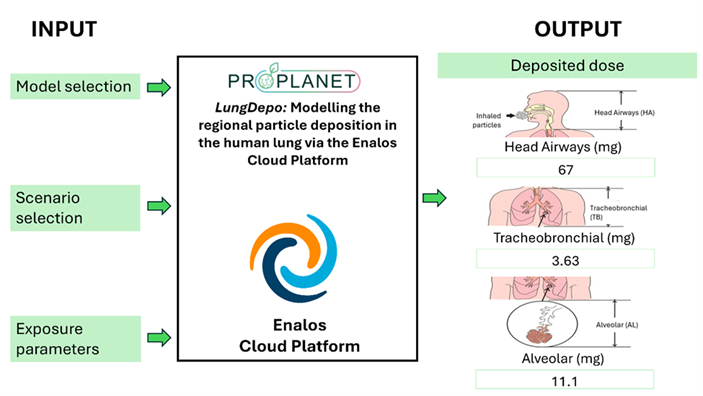
In their paper entitled ‘LungDepo: modelling the regional particle deposition in the human lung via the Enalos Cloud platform’, the authors presnet the development of LungDepo, and describe the web-based tool’s predefined modelling scenarios for various particle-bound substances or co-pollutants such as polycylic aromatic hydrocarbons (PAHs) or per- and polyfluoroalkyl substances (PFAS) and micro-sized engineered materials, along with provision for the inclusion of user-defined particle size distributions.
The motivation behind this work arises from the need to better understand and quantify how airborne particulate matter and particle-bound pollutants deposit in the human lung, as inhalation exposure represents one of the most critical environmental health risks worldwide.
The novelty of this work lies in the development of the first freely accessible web application that combines the International Commission on Radiological Protection (ICRP) and multiple path particle dosimetry (MPPD) models to simulate regional lung deposition of inhaled particles. Unlike previous approaches, LungDepo offers a user-friendly graphical interface and predefined scenarios for substances such as PFAS, PAHs, and engineered microparticles, while also enabling the use of custom particle size distributions.
We found that LungDepo reliably predicts how different sizes of airborne particles deposit across the head airways, tracheobronchial, and alveolar regions of the human lung.
Case studies with PFAS, PAHs, and engineered microparticles confirmed that coarse particles predominantly accumulate in the upper airways, while fine and ultrafine particles penetrate deeper into the lungs, often reaching the alveolar region where they may pose higher health risks.
This paper is important for the Safe- & Sustainable by Design (SSbD) framework of the INSIGHT project because it provides a practical, freely accessible tool to evaluate how inhaled particles and particle-bound substances deposit in different regions of the human lung. By enabling early prediction of inhalation exposure risks for materials such as PFAS, PAHs, and engineered microparticles, LungDepo supports the proactive design of safer and more sustainable chemicals and materials. The integration of user-friendly interfaces, predefined scenarios, and API connectivity ensures that regulators, industry, and researchers can incorporate inhalation toxicity considerations into decision-making at the earliest stages of innovation, aligning directly with the SSbD principles of reducing harm to human health and the environment.
Follow this link to read the full paper.